 TM
Why Neem Karoli Baba Is Called Maharaj-ji: The Names, the Leela and the Love
Why devotees call Neem Karoli Baba "Maharaj-ji", how the village of Neeb Karori gave him his name, his love for Hanuman, Kainchi Dham, his teachings, and the leela we saw up close with the film Hanuman Ansh.
By the Digital Ishtihaar team · Gurugram
If you have spent any time around devotees of Neem Karoli Baba, you will notice something quickly. Almost nobody calls him Neem Karoli Baba. They call him Maharaj-ji. Some say Babaji. In the hills of Kumaon, people simply say "Baba". In books written by his Western devotees, it is almost always Maharaj-ji, sometimes spelled Maharajji.
So why does a saint who owned almost nothing, wore a plaid blanket, and spent his life wandering the plains of North India carry a name that means "great king"? And how did he come to be called Neem Karoli in the first place?
This piece answers both questions, then goes a little further: into the stories, the teachings, and the reason his name is suddenly being searched by a new generation in 2026, after the release of the film Hanuman Ansh, which is inspired by his life.
We have a personal reason for writing this. Our team handles social media and content for Anupriya Nagar, one of the producers of Hanuman Ansh. Over the last few months we have read more about Maharaj-ji, and watched more people discover him, than at any other time in our lives. This is what we learned.
The short answer: what does "Maharaj-ji" mean?
"Maharaj" is a Hindi and Sanskrit word built from two parts: maha, meaning great, and raj, meaning king or ruler. For centuries it has been used as a title for kings, and also, very commonly in North India, as a respectful way to address a holy man, a teacher or a cook in a temple kitchen. The suffix "ji" adds warmth and respect, the same way you would say "Mataji", "Guruji" or "Pitaji".
So when devotees say Maharaj-ji, they are not crowning him. They are using the most natural, affectionate form of respect available in Hindi for someone they love and look up to. It is a family word as much as a formal one.
That is also why the name stuck with his Western devotees. When young Americans and Europeans arrived in India in the 1960s and 70s and sat with him, they heard Indian devotees around them saying "Maharaj-ji", and they simply did the same. When those devotees went home and wrote books, the name went with them.
So why is he called Neem Karoli Baba?
His birth name, according to most accounts, was Lakshmi Narayan Sharma (also written Lakshman Narayan Sharma). He was born around 1900 in Akbarpur, in what is now Uttar Pradesh. As a young man he left home and wandered as a sadhu, and in each place he stayed, people gave him a different name. Records and devotee accounts mention names such as Baba Lakshman Das, Handi Wala Baba ("the baba with the pot"), Tikonia Wala Baba and Chamatkari Baba ("the miracle baba").
The name that stayed comes from a small village in Farrukhabad district called Neeb Karori. The story behind it is one of the best-loved stories about him, and it is told in almost the same way across ashram books, temple accounts and devotee websites.
The train that would not move
As the story goes, the young sadhu boarded a first-class compartment of a train without a ticket. When the conductor found him, the train was stopped and he was asked to get off near the village of Neeb Karori.
He got off quietly and sat down under a tree.
Then the train would not start. The driver tried. Officials were called. By most tellings, another engine was brought to push it, and still it would not move. Eventually someone suggested that the sadhu they had put off the train might have something to do with it. The officials went to him, offered food and an apology, and asked him to get back on.
He agreed on two conditions: that a railway station would be built for the people of the village, who had to walk miles to catch a train, and that railway staff would treat sadhus with more respect. The officials agreed. He boarded, and the train moved.
The station was built. And the sadhu who stopped the train became known, from then on, as the Baba of Neeb Karori, which over time became Neem Karoli Baba.
Whether you read the story as a miracle, a legend or a parable, its point is very much in character. He did not ask for anything for himself. He asked for a station for a village and dignity for wandering monks.
The other names, and what they tell you about him
The long list of names is not just trivia. Each one is a small window into how different people experienced him.
- Handi Wala Baba: the baba with the pot. He was known to carry very little, and to feed people from whatever he had.
- Chamatkari Baba: the miracle baba. Many of the stories told about him involve things that are hard to explain: knowing what was in someone's mind, being in two places, food that did not run out.
- Baba Lakshman Das: a name from his years as a wandering renunciate.
- Maharaj-ji: the name of love, used by the people closest to him.
The names changed with the places, but the descriptions of the man stay remarkably consistent. He was playful. He teased people. He rarely gave long talks. He was almost always wrapped in a blanket. And he constantly turned the conversation away from himself and towards God, towards service, and towards feeding whoever was in front of him.
Why Hanuman is at the centre of everything
You cannot understand Maharaj-ji without understanding his devotion to Hanuman, the monkey god of the Ramayana, the perfect servant of Lord Ram.
Hanuman is strength, but strength in service. He is the devotee who asks for nothing except to serve. In the Hanuman Chalisa, the forty verses that millions of Indians recite every day, Hanuman is praised again and again not for his power but for his devotion.
Maharaj-ji loved Hanuman above every other form of the divine. He encouraged the building of Hanuman temples across North India, and he constantly urged devotees to recite the Hanuman Chalisa. One saying attributed to him captures his whole approach:
"Serve as Hanuman served. Whoever works for God, his work will be done by itself."
Many devotees go further and see Maharaj-ji himself as a form of Hanuman. That belief is exactly where the film Hanuman Ansh takes its title from. Ansh means a part, a fragment or an embodiment. Hanuman Ansh means, roughly, "a part of Hanuman". The film tells the story of a young seeker who sets out in search of Lord Ram and, through faith and seva, becomes the saint the world knows as Neem Karoli Baba. You can read the full synopsis and credits on the official film page and on IMDb.
Kainchi Dham: where the name became a place
If Neeb Karori gave him his name, Kainchi Dham gave his devotees a home.
Kainchi Dham is an ashram and Hanuman temple in the hills of the Kumaon region of Uttarakhand, near Nainital, on the road to Almora. It was built in the 1960s, and its foundation day is celebrated every year on 15 June with a huge bhandara, a community meal, where devotees in very large numbers are fed prasad. The tradition is fitting: feeding people was one of the things Maharaj-ji cared about most.
Today Kainchi Dham is one of the most visited spiritual sites in Uttarakhand. Many of the people who make the journey come because of a book, a podcast, a friend, or, in 2026, a film.
Steve Jobs, Ram Dass and the Western devotees
One reason so many people outside India have heard the name Maharaj-ji is a group of Americans who met him in the 1960s and 70s.
The best known is Ram Dass, the former Harvard psychologist Richard Alpert. His 1971 book Be Here Now became one of the most influential spiritual books of its generation, and his collection Miracle of Love: Stories about Neem Karoli Baba gathered hundreds of first-hand accounts of the saint. The kirtan singer Krishna Das, the physician Larry Brilliant, who worked on smallpox eradication and co-founded the Seva Foundation, and many others trace a turning point in their lives to time spent with him.
Then there are the stories that circulate widely online. Steve Jobs travelled to India in 1974 hoping to meet Neem Karoli Baba, only to learn he had passed away the year before. Years later, Mark Zuckerberg spoke about visiting a temple in India that Jobs had recommended to him, widely reported to be Kainchi Dham. Actor Julia Roberts has spoken publicly about her connection to him. Cricketer Virat Kohli and actor Anushka Sharma have visited Kainchi Dham.
Interestingly, this is also how Anupriya Nagar found him. As her official site tells it, she was researching how technology founders found their direction for a university assignment at the University of Bath. The trail led her to the saint Steve Jobs had hoped to meet. What started as coursework became a book idea, and then a film.
What did Maharaj-ji actually teach?
Here is where the name "Maharaj-ji" becomes almost ironic. For someone called "great king", he taught the simplest things possible.
The teaching most often attributed to him, and repeated by Ram Dass and many devotees, is just this:
"Love everyone, serve everyone, remember God."
Other versions add "feed everyone" or "tell the truth". Another two-word teaching is quoted again and again: "Sab ek", meaning all is one.
People who sat with him rarely remembered long lectures, because there were none. What they remembered was how they felt. As the film page on Anupriya's site puts it, his whole teaching "could sit in a single breath."
In her interviews, Anupriya returns to that same line. Speaking to Deccan Chronicle, she quoted it directly: "Love everyone. Serve everyone. Remember God." And on the film page, she describes what it means in practice:
"I don't see spirituality as something distant. It is something you live every day."
Leela: the word devotees use for what happens around him
There is one more word you will hear whenever devotees talk about Maharaj-ji: leela.
Leela means divine play. It is the idea that God, or a saint, acts in the world playfully, in ways that do not follow ordinary logic, and that the people around them are drawn into a story much bigger than they understand. Devotees use it for the train that would not move, for the stories in Miracle of Love, and for the small coincidences that seem to guide people to Kainchi Dham.
We will be honest with you, because this is our blog and this is our own experience. We have felt that word up close in 2026.
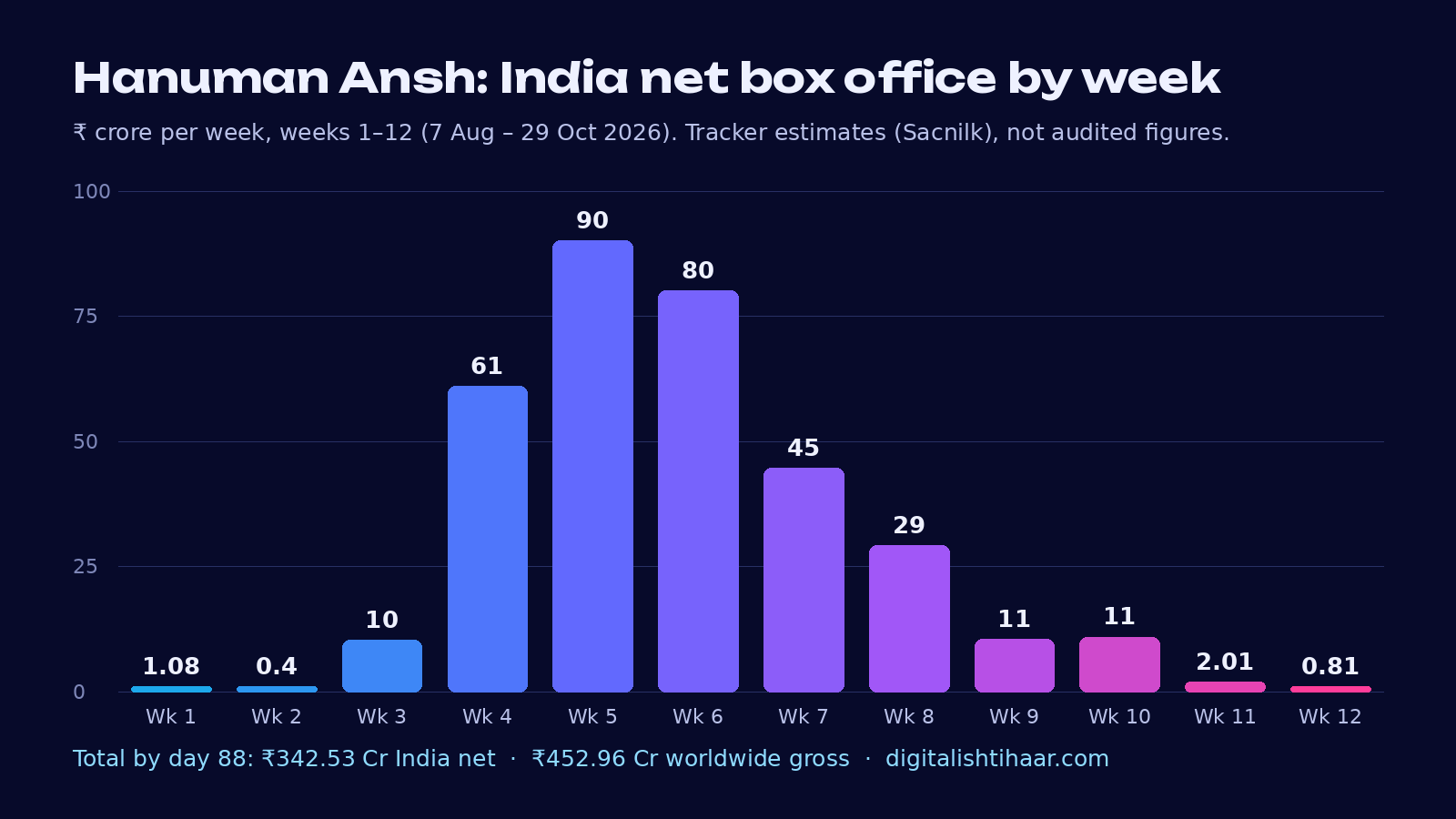
As the team that runs Anupriya's social media and content, we watched Hanuman Ansh go from a film that opened to roughly ₹10 lakh and was being written off in its first week, to one of the most talked-about films of the year. We watched people from every part of India start posting about it without anyone asking them to. We watched saints, artists and families share it on their own.
And we want to say this clearly, because people keep asking: there was no paid PR. Not from us, and not from anyone we know of. We did not pay a single rupee to anybody to write a story, post a review or push the film. A lot of people assume that something this big must have been bought. Only we know how little money there was, and how fast everything happened.
Our founder, Latieka Gill, has seen this leela very closely, and so has our whole team. Everything happened so quickly that, even now, we can't quite believe it happened. The stories are real. We have seen them with our own eyes. If you ask us how a small devotional film with a budget reported at under ₹2 crore found its way to millions of people, our honest answer is the one Anupriya gave to ANI:
"The entire team believe that this is nothing but a miracle of Maharaj Ji."
That is Maharaj-ji's kripa, his grace. And that is his leela, for you. It is so magical that it is genuinely hard to put into words.
Why the name matters in 2026
Search for "Maharaj-ji" or "Neem Karoli Baba" today and you will find a new kind of audience: people in their twenties, many of whom first heard the name through the film, through a reel, or through a celebrity's visit to Kainchi Dham.
This is a generation that is very connected and, often, quietly anxious. Maharaj-ji's message lands with them because it asks for so little and gives so much: love, food, service, presence. No membership, no long rituals, no fees.
Anupriya has spoken about this directly. On her site she describes noticing, while living abroad, how many people her age felt exhausted and were looking for something deeper than success or validation. Hanuman Ansh, she says, is not a film that teaches spirituality, but "one that tries to make you feel it". She has also said she wants people to know his life story and visit his ashram, which is exactly what so many viewers have gone on to do.
Quick facts: Neem Karoli Baba at a glance
- Known as: Maharaj-ji, Babaji, Neem Karoli Baba, Neeb Karori Baba
- Birth name: Lakshmi Narayan Sharma (also written Lakshman Narayan Sharma)
- Born: around 1900, Akbarpur, Uttar Pradesh
- Name from: the village of Neeb Karori, Farrukhabad district
- Devoted to: Hanuman and Lord Ram
- Best-known ashram: Kainchi Dham, near Nainital, Uttarakhand (foundation day 15 June)
- Left his body: 11 September 1973, Vrindavan
- Core teaching: "Love everyone, serve everyone, remember God"
- Film inspired by his life: Hanuman Ansh (2026)
Frequently asked questions
Why is Neem Karoli Baba called Maharaj-ji?
"Maharaj-ji" is a respectful and affectionate Hindi form of address meaning "great king", with "ji" added for respect. North Indian devotees used it for him, and his Western devotees, including Ram Dass, adopted it from them. It is the name of love used by the people closest to him.
Where did the name Neem Karoli come from?
From the village of Neeb Karori in Farrukhabad district, Uttar Pradesh. According to a well-known story, a train he had been asked to leave would not move until he was invited back on board, and a station was later built for the village.
What was Neem Karoli Baba's real name?
Most accounts give his birth name as Lakshmi Narayan Sharma. He was also known as Baba Lakshman Das and by several other names in different places.
Is Neem Karoli Baba considered a form of Hanuman?
Many devotees believe so. He was deeply devoted to Hanuman and encouraged the building of Hanuman temples. The 2026 film Hanuman Ansh, meaning "a part of Hanuman", takes its title from this belief.
What is the film Hanuman Ansh about?
It is a Hindi spiritual drama inspired by the life of Neem Karoli Baba, written and directed by Vishal Chaturvedi and released on 7 August 2026. One of its producers is Anupriya Nagar. See the film page for the story and credits.
Was Hanuman Ansh promoted through paid PR?
Not by us. As the team that handles Anupriya Nagar's social media and content, we did not pay anyone for coverage, reviews or posts. The press coverage, collected on her media page, came from journalists, saints, artists and audiences who chose to talk about the film.
Read next: Hanuman Ansh: the film, the producer and the leela we saw up close and Hanuman Ansh box office explained.