 TM
By the Digital Ishtihaar team · Gurugram · Figures updated to day 88 (2 November 2026)
On its first day in cinemas, Hanuman Ansh earned about ₹10 lakh in India. Eighty-eight days later, box-office trackers put it at roughly ₹342 crore net in India and about ₹453 crore worldwide, on a production budget reported at under ₹2 crore.
Those numbers get shared a lot, often without context. So in this piece we explain, week by week, how the film's box office actually moved, what "net", "gross" and "worldwide" mean, why the second week was the lowest of all, and why the real story is not the size of the total but the shape of the curve.
A note before we start. We are the team that handles social media and content for Anupriya Nagar, one of the film's producers. We are not a PR agency, and we did not pay for any coverage. All the figures below are tracker estimates, mainly from Sacnilk, which also appear on the official film page. They are not audited producer accounts, and different trackers report slightly different totals.
Hanuman Ansh box office at a glance
| Measure | Figure (tracker estimate) |
|---|---|
| Release date (India) | 7 August 2026 |
| Day 1, India net | about ₹10 lakh |
| Week 1, India net | ₹1.08 crore |
| Best week, India net | ₹90.25 crore (week 5) |
| India net, 88 days | ₹342.53 crore |
| India gross, 88 days | ₹404.16 crore |
| Overseas gross | ₹48.80 crore |
| Worldwide gross, 88 days | ₹452.96 crore |
| Reported budget | under ₹2 crore |
| Overseas release | 11 September 2026, through Hombale Films |
Source: Sacnilk day-wise tracker, as of day 88. Bollywood Hungama reports a slightly lower worldwide figure of around ₹442 crore. Full credits and details are on IMDb.
The week-by-week numbers
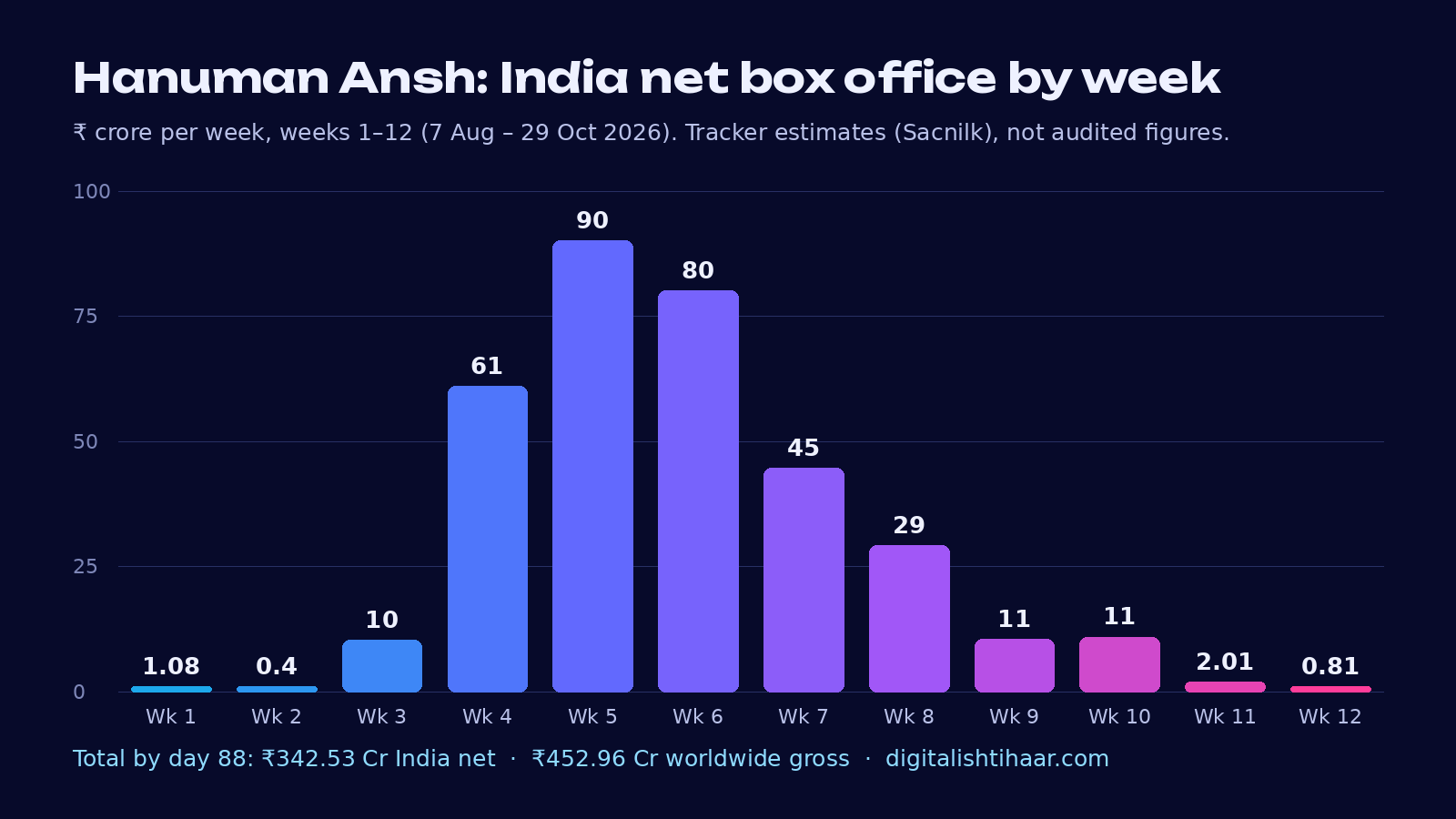
The chart above shows the same weekly figures.
| Week | Days | India net (₹ crore) |
|---|---|---|
| Week 1 | 1–7 | 1.08 |
| Week 2 | 8–14 | 0.40 |
| Week 3 | 15–21 | 10.40 |
| Week 4 | 22–28 | 61.00 |
| Week 5 | 29–35 | 90.25 |
| Week 6 | 36–42 | 80.25 |
| Week 7 | 43–49 | 44.80 |
| Week 8 | 50–56 | 29.20 |
| Week 9 | 57–63 | 10.60 |
| Week 10 | 64–70 | 11.00 |
| Week 11 | 71–77 | 2.01 |
| Week 12 | 78–84 | 0.81 |
| Week 13 (so far) | 85–88 | 0.73 |
| Total | 88 days | 342.53 |
Look at that table for a moment, because it is not what a hit normally looks like.
Why this curve is so unusual
Most Indian films, including the biggest hits, follow a familiar pattern. They open big on the first Friday, peak over the first weekend or the first week, and then decline week after week. Marketing is designed around that: spend heavily before release, fill the cinemas on day one, and hope the drop is gentle.
Hanuman Ansh did the opposite.
- Week 2 was lower than week 1. The film earned just ₹40 lakh in its second week. On a normal release, that is the moment cinemas pull a film. And that is roughly what happened: Deccan Chronicle reported that the film opened on around 300 screens and dropped to about 30 in the first week.
- Week 3 was 26 times week 2. Something changed. With almost no screens and no big campaign, the film earned ₹10.40 crore in its third week.
- Weeks 4, 5 and 6 were the peak. The film earned ₹61 crore, then ₹90.25 crore, then ₹80.25 crore. Screens went up to around 1,500.
- Those three weeks alone add up to ₹231.5 crore, about two-thirds of the film's entire India net total.
In other words, the film did not open big and fade. It opened almost empty and grew, for about a month, before it came down. That is the signature of word of mouth.
What happened in weeks 3 to 6?
Trackers can tell you the "how much". They cannot tell you the "why". But here is what we saw from where we sit, running Anupriya's social media.
People told people. Viewers walked out and messaged their families. Many went back with their parents. Devotees of Neem Karoli Baba, the saint the film is inspired by, shared it in their own circles. If you want to understand why his devotees care so much, we wrote a separate long piece: why Neem Karoli Baba is called Maharaj-ji.
Saints, artists and public figures spoke up on their own. As the film grew, many of them met Anupriya and the team and shared their blessings publicly. The full list, with links to each report, is on her media page.
Cinemas followed the audience. When shows started selling out on small screen counts, exhibitors added shows and screens. That is the reverse of the usual order, where screens are booked first and audiences are hoped for afterwards.
The press followed the numbers. Coverage grew because the story grew. By day 52, trackers were reporting more than ₹300 crore net, and The Week reported that the film had crossed ₹400 crore worldwide in late September.
Was it paid PR?
We get asked this more than any other question, so here is our straight answer.
No. We did not run paid PR. We did not buy articles, pay for reviews, or pay any page, influencer or journalist to talk about the film. We did not pay a single rupee to anybody for coverage. As far as we know, nobody else did either.
A lot of people assume a curve like this must have been bought. But bought promotion does not usually look like this. Paid campaigns are front-loaded: they push an opening. Hanuman Ansh had the weakest opening imaginable and grew afterwards, when there was no budget left to spend.
Our founder, Latieka Gill, and our whole team watched this happen from very close. It happened so fast that we still find it hard to believe. For us, there is only one way to describe it, and it is the way Maharaj-ji's devotees describe everything around him: it was his leela, his divine play, and his kripa, his grace. Anupriya put it the same way when she spoke to ANI:
"The entire team believe that this is nothing but a miracle of Maharaj Ji."
Net, gross and worldwide: what do these words mean?
Box-office reporting in India uses a few terms that confuse almost everyone. Here is a simple guide.
Gross is the total value of tickets sold, including taxes. India gross for Hanuman Ansh is about ₹404 crore.
Net is gross minus GST, the tax charged on cinema tickets. This is the figure most Indian trackers lead with. India net for Hanuman Ansh is about ₹342.5 crore.
Overseas gross is ticket sales outside India, converted to rupees. For Hanuman Ansh this is about ₹48.8 crore, after the film released internationally on 11 September through Hombale Films.
Worldwide gross is India gross plus overseas gross. For Hanuman Ansh that is about ₹453 crore.
What the producers receive is a different number again. Cinemas keep a share of the net, distributors take their share, and the producers' share comes after that. These splits vary by deal and by week and are not public, so nobody outside the business can honestly tell you the film's "profit" from tracker numbers. What we can say is that a budget reported at under ₹2 crore against a net total of over ₹340 crore is an extraordinary ratio by any measure.
How did a ₹2 crore film get made, and finished?
This is the part of the box-office story that rarely makes it into the headlines.
Hanuman Ansh was produced by Ragini Sona, Namrata G. Singh, Anupriya A. Nagar and Dr Vishal Chaturvedi under Swambhu Media Network, with Holy Cow Home Productions. It was written and directed by Vishal Chaturvedi, based on his book Divine Detour. You can see the full credits on IMDb.
The film had been shot, but there was not enough money left to finish it. That is when Anupriya Nagar, then 21 and fresh out of an economics degree at the University of Bath, put in the savings from three years of part-time work in the UK. She told ANI:
"I put all my savings into this film."
And, on the scale of it:
"I contributed one-third of the entire budget."
As an economist, she has been honest that this was not a spreadsheet decision. To Deccan Chronicle she said:
"Some decisions cannot be made only on an Excel sheet."
In the same conversation she added the line we think every young investor should hear: "Faith should never mean ignoring due diligence."
Several people in the industry, she has said, refused to invest even a small amount in the film's post-production. Some of them, according to later interviews, came back after the film's success and admitted it had been a mistake. Her full story, in order and with sources, is on her official site and her journeys page.
What small films, and small brands, can learn from this curve
We work in content and social media every day, so we have thought a lot about what this run teaches. Not as a formula, because nobody can promise a result like this, but as a set of honest lessons.
A weak opening is not the end of the story. For years the industry has treated the first weekend as a verdict. Hanuman Ansh shows that a film with real emotional pull can recover from almost nothing, if people are given a reason to talk about it.
Sincerity travels further than spend. The film's launch was devotional, not glamorous: its first poster was unveiled at Baba's samadhi in Vrindavan, amid the Hanuman Chalisa and a bhandara. Audiences could feel that the people behind it believed in it. That belief is very hard to fake.
Let real people tell the story. The most powerful posts about the film were not made by any team. They were made by viewers, families, devotees and saints, in their own words. Good social media management, in our experience, is mostly about making it easy for those voices to be heard and shared, not about shouting louder.
Be transparent about the numbers. Every figure on the film page is labelled as a tracker estimate, with its source and date. That honesty builds trust, and trust is what makes people share.
None of this explains everything. Some of it, as we said above, we can only call grace.
Key milestones
- 7 August 2026: released in India; about ₹10 lakh on day 1.
- Week 1: about ₹1.08 crore; screens drop from around 300 to around 30.
- Week 2: ₹40 lakh, the lowest week of the run.
- Week 3: ₹10.40 crore; word of mouth begins to show.
- Week 4: ₹61 crore; the film breaks out.
- Week 5: ₹90.25 crore, the best week of the run.
- 11 September: international release through Hombale Films.
- Day 52: more than ₹300 crore India net reported by trackers.
- Late September: crosses ₹400 crore worldwide, as reported by The Week.
- Day 88 (2 November): ₹342.53 crore India net, ₹452.96 crore worldwide (Sacnilk).
What the numbers do not show
Box-office tables cannot capture what we saw every day in the comments and messages: people writing that they cried in the cinema, that they took their grandparents, that they booked a trip to Kainchi Dham, Neem Karoli Baba's ashram in Uttarakhand, after watching it.
For Anupriya, the money was never the point. On her film page she writes:
"I don't believe I chose this journey. I feel it chose me."
And on her homepage:
"Real ambition, I've learned, is creating something that emotionally stays with people."
For the full story of the film itself, read our companion piece: Hanuman Ansh: the film, the producer and the leela we saw up close.
Frequently asked questions
How much has Hanuman Ansh earned at the box office?
As of day 88 (2 November 2026), trackers estimate about ₹342.5 crore net in India, ₹404 crore India gross and about ₹453 crore worldwide gross (Sacnilk). Other trackers report slightly different totals. These are estimates, not audited figures.
What was the budget of Hanuman Ansh?
The budget has been reported at under ₹2 crore.
What was Hanuman Ansh's day 1 collection?
About ₹10 lakh net in India on 7 August 2026, according to trackers.
What was the best week for Hanuman Ansh?
Week 5 (days 29 to 35), with about ₹90.25 crore India net.
Why did Hanuman Ansh grow after a weak opening?
Word of mouth. The film opened on few screens and dropped to around 30 in week 1, then grew from week 3 as audiences recommended it, saints and public figures shared it, and cinemas added screens, reaching around 1,500.
Did Hanuman Ansh use paid PR or paid reviews?
Not from us. Digital Ishtihaar manages Anupriya Nagar's social media and content only. We did not pay for any press, reviews or posts, and we are not a PR agency.
Who produced Hanuman Ansh?
Ragini Sona, Namrata G. Singh, Anupriya A. Nagar and Dr Vishal Chaturvedi. See IMDb for full credits.