 TM
By the Digital Ishtihaar team · Gurugram
Some films are launched. Hanuman Ansh was carried.
It opened in August 2026 with almost no noise, was cut from most screens in its first week, and was quietly written off by people who had seen many small films disappear. A few weeks later it was playing in more than a thousand cinemas, families were going back to watch it a second time, and the name Neem Karoli Baba was being searched by people who had never heard it before.
This is the story of that film: what it is about, who made it, the 21-year-old producer who put her savings into it, and what we, as the team that handles her social media and content, saw happen from very close. We will also say plainly what we did not do, because people ask us all the time.
What is Hanuman Ansh about?
Hanuman Ansh is a Hindi spiritual drama inspired by the life of Sri Neem Karoli Baba, the saint his devotees call Maharaj-ji. It was written and directed by Vishal Chaturvedi and released in cinemas across India on 7 August 2026.
The film follows a grieving young man who, after the death of his mother, sets out to find God. He goes looking for Lord Ram, and through faith and seva, selfless service, he becomes the barefoot saint whose message of love, food and service eventually reached people all over the world.
The title explains its heart. Ansh means a part or an embodiment. Many devotees believe Neem Karoli Baba was a form of Hanuman, the devoted servant of Lord Ram, so "Hanuman Ansh" means, roughly, a part of Hanuman. If you want the background on the saint himself, we wrote a separate long piece on why Neem Karoli Baba is called Maharaj-ji.
The official film page describes the film in a way we think is exactly right. It is "not a biopic and it is not a lecture." It is a spiritual journey that does not try to teach you spirituality so much as let you feel it. Its emotional centre is bhakti, the path of love and surrender.
The credits, in one place
Full credits are listed on the film's IMDb page and on the film page. The key names:
- Written and directed by: Vishal Chaturvedi
- Produced by: Ragini Sona, Namrata G. Singh, Anupriya A. Nagar and Dr Vishal Chaturvedi
- Production companies: Swambhu Media Network, Holy Cow Home Productions
- Starring: Shobhinaw Satyaa as Neem Karoli Baba, with Chandan Anand, Purnima Tiwari, Vihaan Shedge and Anil Rastogi
- Cinematography: Vishal Bawa
- Editing: Shankh Rajadhyaksha
- Music: Sadhu Sushil Tiwari
- Based on: the book Divine Detour by Vishal Chaturvedi
- Distribution: Cinépolis in India, Hombale Films overseas
- Language: Hindi
One detail many people miss: the American kirtan singer Krishna Das, one of Neem Karoli Baba's best-known Western devotees, sings two chants in the film.
The producer: Anupriya Nagar
Of the four producers, the one whose story has travelled furthest is Anupriya Nagar. She was 21 when she backed the film, which has made her one of the youngest feature-film producers anywhere. Her IMDb profile is here.
Her route into cinema was not planned. As her official site tells it:
- It started with an assignment. At the University of Bath, where she read economics, she was researching how technology founders found their direction. The trail led to Neem Karoli Baba, the saint Steve Jobs travelled to India hoping to meet. Coursework became a book idea.
- She turned down a job. She had a job waiting in Switzerland. Instead she came back to India in 2025, met director Vishal Chaturvedi, and joined the team while the film was in post-production.
- She put in her savings. The film had been shot, but there was not enough money to finish it. Anupriya put in the savings from three years of part-time work in the UK. She told ANI: "I put all my savings into this film," adding, "I contributed one-third of the entire budget." The budget has been reported at under ₹2 crore.
She is also refreshingly honest about the decision. To Deccan Chronicle she said:
"Some decisions cannot be made only on an Excel sheet."
And in the same interview, a line that tells you she is still an economist:
"Faith should never mean ignoring due diligence."
On her film page she describes how it felt:
"I don't believe I chose this journey. I feel it chose me."
Before the team began, she writes, they completed forty-three days of the Hanuman Chalisa, and "wherever we went, the Chalisa came with us."
A launch at a samadhi, not on a red carpet
Hanuman Ansh did not get a glitzy launch. Its first poster was unveiled at Baba's samadhi in Vrindavan, with the Hanuman Chalisa and a traditional bhandara, surrounded by devotees rather than press. The film's imagery was carried to temples and sacred spaces first.
That choice says a lot about the spirit of the project. The film page calls it "a devotee-led launch, not a premiere", shaped around a single principle: reverence. The aim was never a weekend of noise. It was a film that keeps finding new audiences, quietly, for years.
The first week: almost nobody came
Here is the part of the story that makes the rest of it hard to believe.
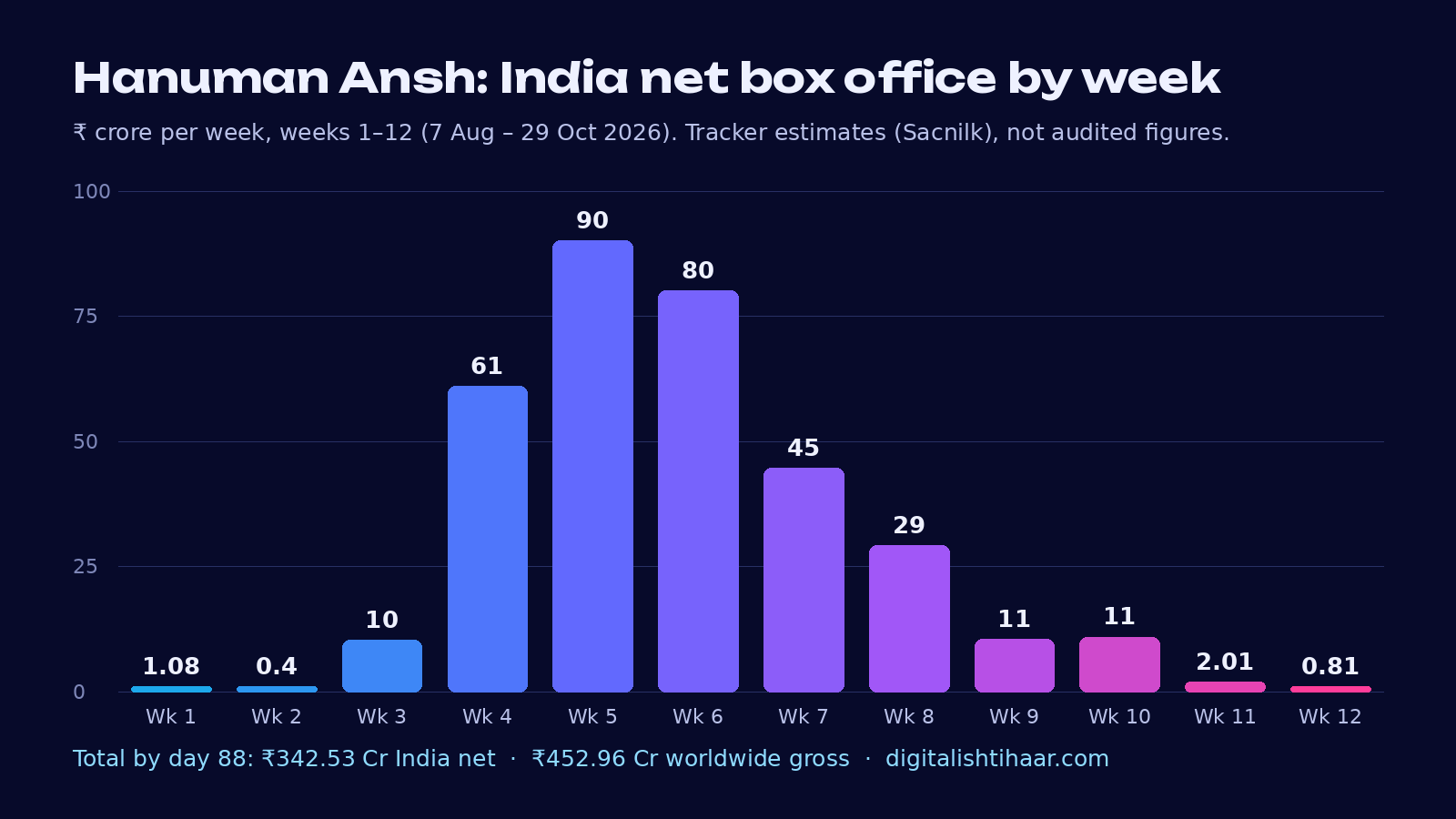
On its first day, Hanuman Ansh earned roughly ₹10 lakh in India, according to box-office trackers. Deccan Chronicle reported that it opened on around 300 screens and dropped to about 30 in its first week. Shows were cut. Several people in the industry, as Anupriya later told interviewers, had refused to invest even a small amount in its post-production because they did not believe a low-budget devotional film with a debutant director and a newcomer cast could work.
Bollywood Hungama reported that, at one point, she thought about going back to Zurich.
Then the audience took over
What happened next was not a marketing plan. People who had seen the film started telling other people to go. Families went back with their parents. Devotees of Maharaj-ji posted about it. Saints and artists shared it on their own pages.
By the end of its fourth week, the film was earning tens of crores a week. Screens went from around 30 to about 1,500. By day 52, trackers were reporting more than ₹300 crore net in India. By late October, trackers put it at roughly ₹342 crore net in India and around ₹450 crore worldwide, after an international release through Hombale Films on 11 September.
We have written a separate, detailed breakdown of those numbers, week by week, with the caveats that come with tracker figures: Hanuman Ansh box office explained.
Why it connected, especially with young people
Devotional films are not new in India. So why did this one travel the way it did?
We think there are three reasons, and all three are visible in what audiences posted about it.
It is about a feeling, not a lecture. Neem Karoli Baba's teaching is famously short: love everyone, serve everyone, remember God. The film keeps that simplicity. People did not walk out talking about a plot twist. They walked out talking about how they felt, and they wanted the people they love to feel it too.
The saint already had a global story. Maharaj-ji is the saint Steve Jobs went looking for, the guru of Ram Dass and Krishna Das, and the reason so many people make the journey to Kainchi Dham in the Kumaon hills. Young viewers who had heard those stories on podcasts and in reels finally had a film that told his.
The producer was one of them. A 21-year-old economics graduate who turned down a job abroad and put her savings into a devotional film is a story that young Indians, and young people of Indian origin abroad, could see themselves in. Anupriya has spoken about noticing, while living in the UK, how many people her age felt exhausted and were searching for something deeper than success or validation. Hanuman Ansh, she says, is her answer.
None of these things can be bought. They can only be felt, and then shared.
Blessings, meetings and recognition
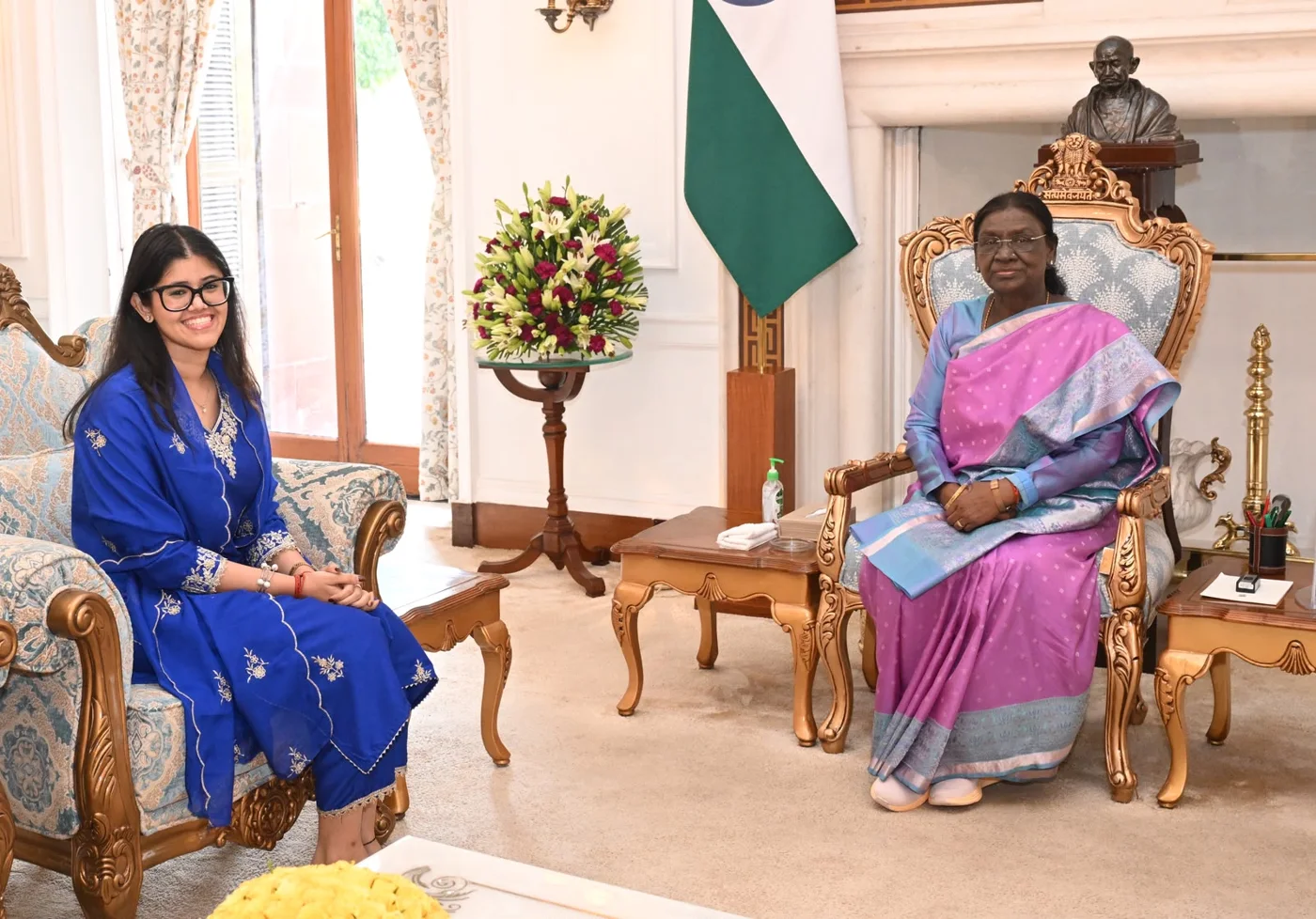
As the film grew, saints, artists and public figures began to meet Anupriya and the team, and to speak about the film on their own. They include Premanand Ji Maharaj in Vrindavan, who gave his blessings, and, in October, the Hon'ble President of India. Actor Sanjay Dutt posted a photo with her and told her: "your story has only just begun."
Anupriya has been invited to speak at the House of Lords in London, at TEDxSRCC 2026 at Shri Ram College of Commerce in Delhi, and at IIT Kanpur, and she has taken the film's message to more than 65 schools and universities in the UK. The full list, with links to each report, is on her journeys page and her media page.
To be clear: these were Anupriya's meetings and invitations, not ours. We help her share them on social media.
Our role: social media and content, nothing more
People sometimes assume an agency must have been behind a story like this. So here is exactly what we do, and what we do not.
What we do for Anupriya Nagar:
- We manage her social media: Instagram, YouTube and X.
- We plan and create content: posts, reels, captions and the content calendar.
- We help with content strategy and her official website, anupriyanagar.com.
What we do not do:
- We are not a PR agency for the film.
- We did not buy press coverage, place paid articles or pay for reviews.
- We did not pay anyone, journalists, influencers or pages, to talk about Hanuman Ansh.
The leela we saw up close
We want to end with something personal, because it is the most honest part of this story.
A lot of people say the film's success must have been paid for. We understand why. When a small devotional film goes from ₹10 lakh on its first day to hundreds of crores, it is natural to assume someone spent a fortune on promotion.
There was no paid PR. We did not pay a single rupee to anybody. Only we know how little money there was, and how fast everything moved.
Our founder, Latieka Gill, and our whole team have watched this unfold from very close, day by day, post by post. Everything happened so quickly that, honestly, we still can't believe it happened. The stories you have read are real. The people who walked out of cinemas in tears were real. The saints and families who shared the film did it on their own.
In the language of Maharaj-ji's devotees, there is only one word for it: leela, divine play. Everything happened with Maharaj-ji's kripa, his grace. Anupriya said it best, speaking to ANI:
"The entire team believe that this is nothing but a miracle of Maharaj Ji."
That is Maharaj-ji's leela, for you. We saw it all, and it was so real and so magical that we still find it hard to express in words.
What comes next
A sequel, Hanuman Ansh 2, has been announced. Anupriya continues to take the film's message to students, to Kainchi Dham, to Vrindavan and to Ayodhya. And she keeps returning to the same idea she shared on her site:
"Real ambition, I've learned, is creating something that emotionally stays with people."
Frequently asked questions
What is Hanuman Ansh?
A 2026 Hindi spiritual drama inspired by the life of Neem Karoli Baba (Maharaj-ji), written and directed by Vishal Chaturvedi and released in India on 7 August 2026. See the film page and IMDb.
Who produced Hanuman Ansh?
Ragini Sona, Namrata G. Singh, Anupriya A. Nagar and Dr Vishal Chaturvedi, under Swambhu Media Network, with Holy Cow Home Productions.
Who is Anupriya Nagar?
An economist from the University of Bath, an artist, and one of the producers of Hanuman Ansh, which she backed at 21 with her own savings. Read more on her about page or IMDb.
Who plays Neem Karoli Baba in Hanuman Ansh?
Shobhinaw Satyaa plays Neem Karoli Baba.
Is Hanuman Ansh based on a book?
Yes. It is based on Divine Detour by Vishal Chaturvedi, who also wrote and directed the film.
Did Hanuman Ansh use paid PR?
Not from us. Digital Ishtihaar handles Anupriya Nagar's social media and content only. We did not pay anyone for coverage, reviews or posts, and we are not a PR agency for the film.
Is there a Hanuman Ansh 2?
A sequel, Hanuman Ansh 2, has been announced. Follow anupriyanagar.com for updates.